





How To Fertilize Orchids Naturally: Organic & Homemade Orchid Fertiliser Options


How To Fertilize Orchids Naturally: Organic, DIY & Homemade Orchid Fertiliser Options
If you’re wondering how to feed orchids naturally, the good news is you don’t need harsh chemicals or expensive liquid feeds. By using natural orchid fertiliser or making simple homemade orchid fertiliser, you can encourage healthy growth, vibrant blooms, and resilient plants.
Orchids (Orchidaceae) are stunning plants, but their beauty depends on proper care and nutrition. Switching to organic and DIY orchid fertilisers not only nurtures your orchids but also helps the environment by reducing chemical runoff. Whether you prefer kitchen-based solutions, slow-release natural mixes, or organic store-bought options, this guide will show you how to feed orchids naturally using sustainable, nutrient-rich ingredients.
Understanding Orchid Nutritional Needs
To feed orchids naturally, it’s vital to understand their unique nutritional requirements. Unlike most houseplants, orchids are epiphytes – plants that grow on trees or other surfaces without drawing nutrients from soil. In the wild, they rely on decayed organic matter, rainwater, and minerals from bark or moss. To recreate this environment indoors or in pots, you need to provide a gentle balance of nutrients when using natural orchid fertiliser or DIY orchid food blends.
Key Orchid Nutrients and Their Roles
-
-
Nitrogen (N): Drives lush leaf and stem development. Organic sources like compost tea, kelp extract, or fish emulsion are ideal. Too much nitrogen, however, can weaken blooms, so moderation is key.
-
Phosphorus (P): Crucial for flower buds, root growth, and strong pseudobulbs. Organic bone meal or banana peel water provides a natural phosphorus boost.
-
Potassium (K): Helps orchids resist disease, maintain hydration, and improve flower colour intensity. Potassium-rich options include banana peels, coconut water, or wood ash (used sparingly).
-
Calcium (Ca): Strengthens root cell walls and supports balanced growth. Crushed eggshells or dolomite lime are effective natural plant food sources.
-
Magnesium (Mg): Encourages deep green leaves through chlorophyll production. Epsom salt, used occasionally, is a great natural magnesium supplement.
-
Micronutrients: Orchids also benefit from trace elements such as iron, zinc, boron, and manganese. Seaweed extract and worm tea contain these in natural, bioavailable forms.
-
Recommended NPK Ratios for Orchids
Understanding the right NPK ratio that plants need is fundamental to their health. For general orchid maintenance, a balanced NPK ratio around 20-20-20 works well. When you are feeding your orchids organically or using homemade blends, go for a much gentler formula by diluting it to about one-quarter strength. Orchids have delicate roots that can easily burn if overfed, so a light hand with fertiliser helps keep them thriving without stress.
Depending on growth stage, you can slightly adjust:
-
-
During vegetative growth: Aim for a nitrogen-leaning ratio, roughly 30:10:10, or a natural equivalent high in leafy nutrients (like kelp and fish emulsion).
-
Before and during blooming: Lower nitrogen and increase phosphorus and potassium for abundant flowers – roughly 10:30:20 or an organic version made from bone meal and banana water.
-
Maintenance feeding: A balanced, consistent supply like 15:15:15, achieved through diluted seaweed or compost tea, keeps the roots and leaves healthy throughout the year.
-
Nutrient Absorption and Feeding Method
Since orchids absorb nutrients through their roots and leaf pores, foliar feeding can be beneficial. Mist diluted DIY orchid fertiliser every few weeks on leaves and aerial roots to enhance uptake. However, never spray during high heat or direct sunlight, as this may scorch tissues.
Rrchids prefer “weakly, weekly” feeding – low concentrations applied more frequently. This mimics the gentle, continuous nutrient flow they’d receive in nature when rainwater trickles over decaying matter.
Homemade Orchid Fertilisers
Creating homemade orchid fertiliser is an accessible way to feed orchids organically using everyday kitchen scraps and household items. DIY orchid fertilisers deliver gentle, targeted nutrition that mimics the orchids’ natural habitat, avoiding the risks of synthetic overload.
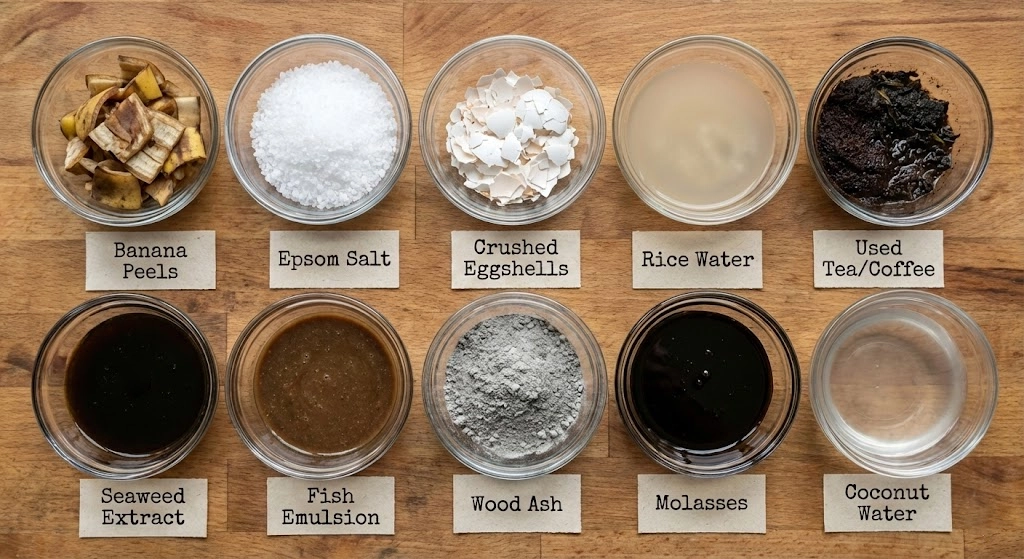
Ingredients For Homemade Orchid Fertiliser and Their Effects
| Ingredient | NPK Impact (Increases) | Macronutrients (Increases) | Micronutrients (Increases) |
|---|---|---|---|
| Banana Peels | High K (3-1-42); boosts potassium | Potassium, Phosphorus | Magnesium, Calcium; cytokinins for blooms |
| Epsom Salt | Neutral NPK (0-0-0 + Mg); no direct NPK change | Magnesium, Sulfur | Enhances chlorophyll; prevents Mg deficiency |
| Crushed Eggshells | Neutral NPK (0-0-0 + Ca); minor P boost | Calcium, Phosphorus | Carbonates; buffers pH for root health |
| Rice Water | Low N (1-0-0); gentle nitrogen rise | Nitrogen, Carbohydrates | B vitamins, amino acids, Zinc for roots |
| Used Tea/Coffee | N-focused (2-1-1); increases nitrogen | Nitrogen, mild P & K | Iron, Manganese; antioxidants for leaves |
| Seaweed Extract | Balanced trace (0.1-0.1-1.5); minor all NPK | Trace NPK overall | 60+ micros (Zn, Fe, B); hormones for growth |
| Fish Emulsion | N-heavy (5-1-1); strong nitrogen boost | Nitrogen, Phosphorus | Amino acids, enzymes for vigor |
| Wood Ash | High K (0-1-7); potassium surge | Potassium, mild P | Calcium, Magnesium; raises pH sparingly |
| Molasses | Low K (0-0-5); potassium & microbial aid | Potassium, Carbohydrates | Iron, Calcium; feeds beneficial microbes |
| Coconut Water | Trace K/P (0-0-2); mild potassium/phosphorus | Potassium, Phosphorus | Cytokinins, enzymes for flower buds |
Homemade Orchid Fertiliser Recipes
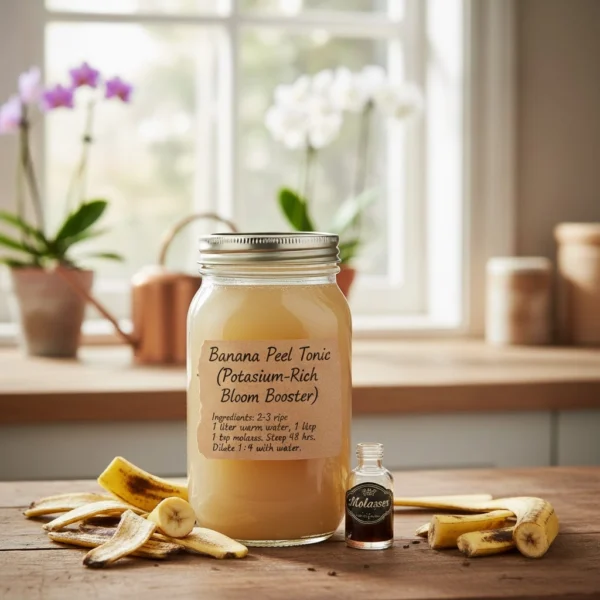
Banana Peel Tonic (Potassium-Rich Bloom Booster)
Banana peels are a powerhouse for how to make fertiliser for orchids, primarily increasing K (potassium) for vibrant flowers and strong roots.
-
-
-
Ingredients: 2-3 ripe banana peels, 1 liter warm water, optional 1 tsp molasses (for microbial boost).
-
Preparation: Chop peels finely,add to water, steep 48 hours in a covered jar, strain out the solids. Dilute 1:4 with water.
-
Application: Water roots every 2 weeks during bloom season; foliar spray lightly. Expect enhanced flower spikes within 4-6 weeks.
This DIY orchid food also provides minor phosphorus and magnesium, supporting overall vigor without salt buildup. - Precautions:
- Avoid direct application of banana peels; ethylene gas accelerates aging, fungus grows in steeps, and it attracts ants or aphids.
- Use sparingly to prevent nutrient excess; supplement, don’t replace balanced feeds during growth phases.
- Strain thoroughly and dilute heavily; monitor for leaf yellowing or pests weekly.
-
-
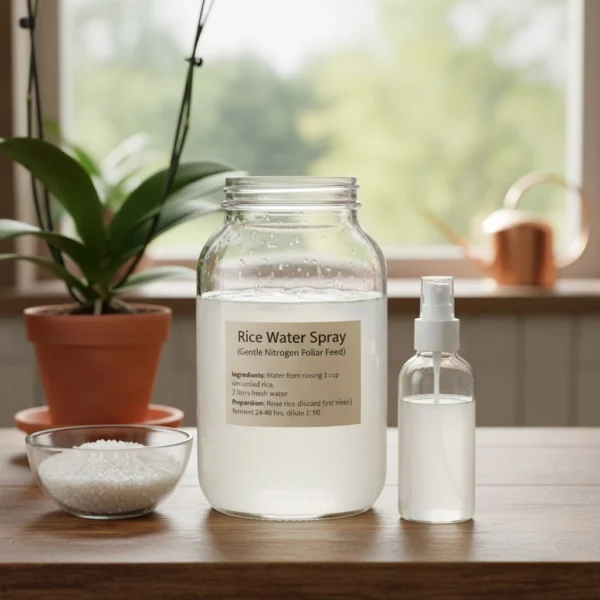
Rice Water Spray (Gentle Nitrogen Foliar Feed)
Rice water excels as a natural orchid fertiliser by increasing N (nitrogen) mildly, ideal for leaf growth.
-
-
-
Ingredients: Water from rinsing 1 cup uncooked rice, 2 liters fresh water.
-
Preparation: Rinse rice thoroughly (discard first rinse), let second rinse water ferment 24-48 hours at room temp. Dilute 1:10.
-
Application: Mist leaves and aerial roots every 2-4 weeks; avoid during flowering to prevent residue. Great for weak orchids recovering from repotting.
Rich in B vitamins and amino acids, it promotes glossy foliage and subtle starch for energy reserves. - Precautions:
- Dilute 1:10 minimum; undiluted starch hardens medium, blocks drainage, and causes root rot.
- Ferment briefly (24-48 hours max) with plain water; excess invites gnats, mold, or odors.
- Limit to every 2-4 weeks as supplement only; flush pot monthly with plain water.
-
-
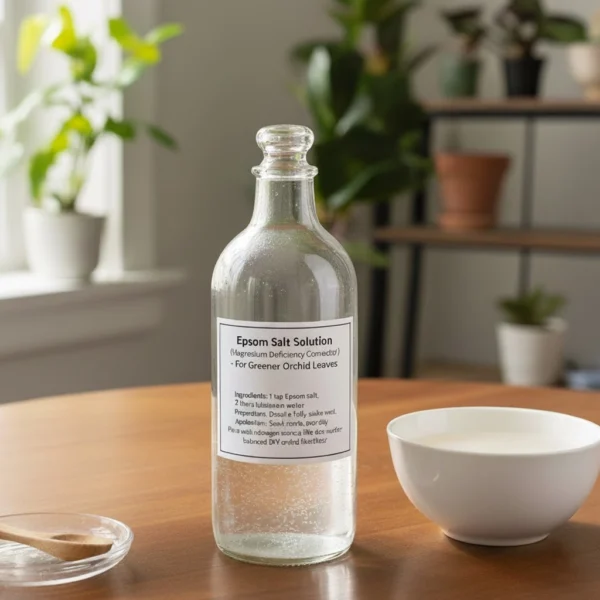
Epsom Salt Solution (Magnesium Deficiency Corrector)
For feed orchids organically with greener leaves, Epsom salt increases Mg (magnesium) and sulfur, countering common indoor deficiencies.
-
-
-
Ingredients: 1 tsp Epsom salt (magnesium sulfate), 2 liters lukewarm water.
-
Preparation: Dissolve fully, shake well before use. No steeping needed.
-
Application: Soak roots monthly (quarter strength for young plants); alternate with other feeds. Watch for deeper green color in 2 weeks.
Pairs perfectly with nitrogen sources like rice water for balanced DIY orchid fertiliser. - Precautions:
- Dissolve fully and use at quarter strength for young plants; excess salts harm roots in bark media.
- Apply monthly max, alternating with other feeds; flush afterward with plain water to remove buildup.
- Test on one plant first; overapplication may not promote blooms and risks dehydration.
-
-
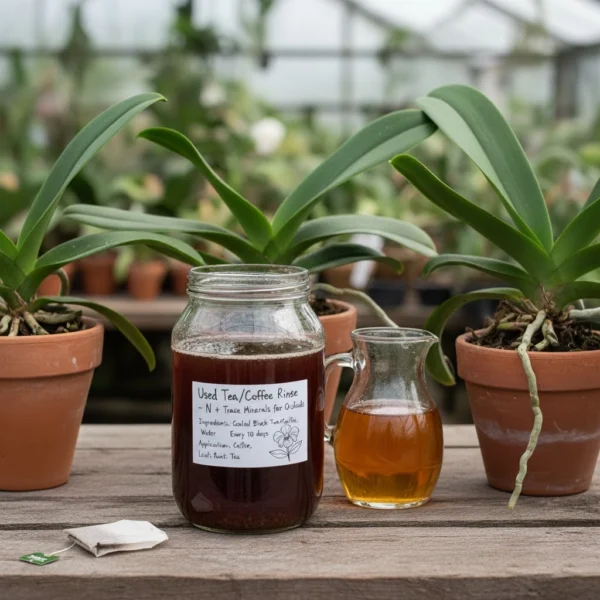
Used Tea or Coffee Rinse (Nitrogen and Trace Mineral Blend)
Cooled tea or coffee grounds water increases N (nitrogen) with hints of iron and manganese, making it a versatile homemade orchid fertiliser for vegetative stages.
-
-
-
Ingredients: Brewed black tea/coffee (cooled, no milk/sugar), 4 parts fresh water.
-
Preparation: Use weak brew from 1 tea bag or 1 tsp grounds per liter; let sit overnight, strain.
-
Application: Water every 10 days; coffee suits leaf-focused growth, tea for roots. Flush pots monthly to prevent acidity.
Antioxidants aid stress resistance, enhancing natural orchid care routines. - Precautions:
- Brew weakly and strain; grounds or leaves mold in bark, rotting medium and blocking airflow.
- Flush pots monthly; acidity from caffeine stunts growth without soil microbes to break it down.
- Use during vegetative stage only; avoid as nitrogen substitute for epiphytes.
-
-
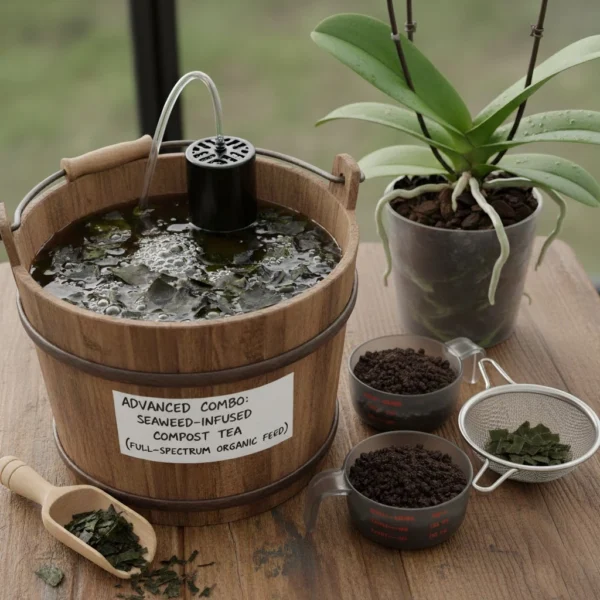
Advanced Combo: Seaweed-Infused Compost Tea (Full-Spectrum Organic Feed)
For the best natural plant food for orchids, blend dried seaweed (kelp) with worm castings to increase trace NPK and 60+ micronutrients like zinc and boron.
-
-
-
Ingredients: 1 tbsp dried kelp meal, 1 cup worm castings/compost, 1 gallon water, 1 tbsp molasses.
-
Preparation: Steep in bucket 3-5 days (aerate daily with aquarium pump if possible), strain, dilute 1:10.
-
Application: Use biweekly as root drench; boosts hormones for keikis (plantlets) and recovery.
This DIY orchid food fosters microbial life in bark medium, mimicking rainforest nutrient cycling. - Precautions:
- Aerate during steeping to promote aerobic bacteria; anaerobic leachate can harm plants and worms.
- Dilute 1:10 and use biweekly; overuse leads to salt or nutrient overload in pots.
- Source quality kelp and castings; strain well to prevent clogs, and flush regularly
-
-
Mixing and Safety Tips for Success
-
- Reference the nutrient impact table to combine recipes – e.g., banana peels + rice water increases K and N for blooming.
- Always use “weakly, weekly” timing: dilute heavily, apply sparingly, apply after watering, and flush with plain water monthly to prevent salt accumulation.
- Always test homemade fertilisers on one pseudobulb first, especially for sensitive species like Phalaenopsis.
Selecting Natural Fertilisers for Orchids From The Store
If you prefer convenience, several orchid fertiliser options are available that align with natural and organic orchid care practices.



Factors to Check For When Selecting Organic Orchid Fertiliser Options
1) Certification and Purity Standards
Look for certified organic seals like OMRI (Organic Materials Review Institute), USDA Organic, or Australian Certified Organic to guarantee no synthetic pesticides or fillers. Avoid products with urea-based nitrogen, which breaks down into salts harmful to orchids. Instead, opt for hydrolysates or extracts from kelp, fish, or compost.
2) NPK Balance and Formulation Type
Choose orchid-specific ratios like 20-20-20 or 10-30-20 for balanced feeding, with clear labeling of natural sources (e.g., “derived from seaweed”). Liquid concentrates or water-soluble powders suit frequent, dilute applications; avoid heavy granules that compact bark media.
3) Product Form
The product form determines how effectively an organic fertiliser for orchids integrates into your natural orchid care routine, matching orchids’ need for gentle, frequent feeding in bark or moss media. Select formats that dissolve easily and avoid residue buildup.
-
-
-
Liquid Concentrates: Most versatile for “weakly, weekly” application. Dilute 1/4 tsp per gallon and apply via watering can or foliar spray. Fast absorption through roots and leaves suits Phalaenopsis and Dendrobium.
-
Water-Soluble Powders: Mix instantly for custom strength; ideal for precise NPK control in multi-plant collections. No clogging in humid environments.
-
Slow-Release Pellets or Spikes: Embed in medium for 2-3 months of steady nutrition; best for forgetful growers but test sparingly to prevent over-fertilization.
-
-
Avoid: Heavy granules or cakes that compact bark and impede aeration, or oil-based emulsions that coat roots.
Best: Liquids and powders dominate as the best natural plant food for orchids for consistent, burn-free feeding
4) Ingredient Transparency and Additives
Demand full disclosure: top ingredients should list fermented fish emulsion, humic acids, or mycorrhizal fungi. Steer clear of added surfactants, dyes, or preservatives that disrupt microbial life in the root zone.
5) Ingredient List
Prioritize products featuring these proven, natural components that deliver balanced nutrition without synthetic additives, ensuring compatibility with orchid epiphyte roots.
-
-
-
Kelp/Seaweed Extract (Ascophyllum nodosum): Supplies natural auxins, cytokinins, and trace minerals (Zn, Fe, B) to stimulate root growth and stress resistance – ideal for natural orchid care.
-
Fish Hydrolysate or Emulsion: Provides amino acids and a gentle 5-1-1 NPK boost for foliage vigor; choose cold-processed versions to retain enzymes.
-
Worm Castings or Compost Tea Extract: Rich in humic acids and beneficial microbes that enhance nutrient uptake in bark media.
-
Bat Guano or Bone Meal: Phosphorus-heavy (3-10-1) for bloom spikes; select high-solubility forms to avoid clumping.
-
Molasses or Alfalfa Extract: Feeds soil microbes while adding potassium and triacontanol for faster recovery and greener leaves.
-
-
6) Concentration Strength and Dilution Instructions
Select products recommending 1/4 to 1/2 teaspoon per gallon (3.8L) to suit a weekly feeding schedule. Check for pH-neutral formulas (5.5-6.5) to prevent root burn in acidic bark mixes.
Switching to natural orchid fertiliser and homemade orchid fertiliser options transforms your routine into sustainable natural orchid care. Experiment with these DIY orchid fertiliser recipes and store-bought picks. Your orchids will reward you with lush growth and spectacular blooms. Happy gardening!
Read More from Pestrol:
-
- Liquid Fertiliser Guide: Benefits, Types & Application Tips for Healthier Plants
- Potassium Fertiliser: What You Need To Know For Better Plant Growth
- Nitrogen Fertiliser: Benefits, Uses & Best Practices for Healthy Plant Growth
- Urea Fertilisers Explained: Benefits, Types, and Best Practices for Your Garden
- Phosphorus in Fertilisers: Importance, Benefits and Best Practices for Garden Health
- The Best Season for Fertiliser: Feeding Your Garden in Spring
 Mosquito Traps