

How to Place Fire Ant Gel Bait Safely: A Step-by-Step Guide to Syringe Application

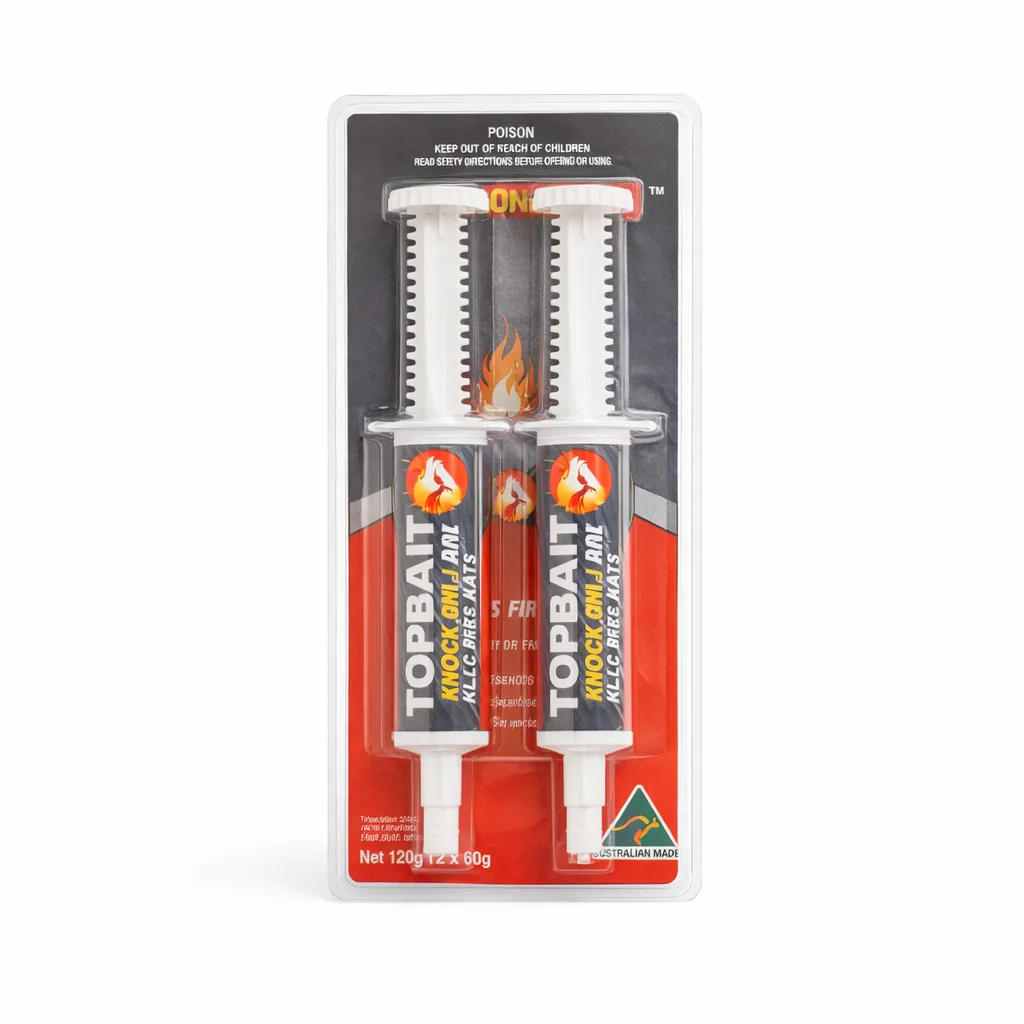
Placing fire ant gel bait safely requires accurate dosing, careful positioning and patience. Topbait Knock-On Fire Ant Bait is supplied as two 60g syringes for targeted treatment of individual fire ant nests, with a recommended application rate of 4g per nest.
At a glance
Twin Pack Supply
The twin pack contains two 60g syringes of gel bait.
Measured Nest Dose
Apply 4g of gel to each individual fire ant nest.
Targeted Placement
Place bait near active nests for foraging ants to access.
Optional Treatment Station
Treatment stations may help reduce contamination or removal.
Follow-Up Treatment
Weekly applications may be needed for three or more weeks.
Before applying the bait
Read the current product label and any applicable local fire ant control directions before use. Confirm that you have identified an active fire ant nest and choose a time when you can approach and place the bait without putting yourself at risk.
Topbait Knock-On contains hydramethylnon at 10g/kg and is approved as a gel treatment for individual fire ant nests under APVMA approval number 91476/132341. Keep the syringe secured until you are ready to apply it, and avoid unnecessary disturbance of the nest.
Step-by-step syringe application
1. Locate an active nest
Place the gel near an active nest, where foraging ants can find and consume it. Avoid treating inactive areas or scattering bait widely when the product is intended for individual-nest treatment.
2. Measure the dose
Apply 4g of gel per individual nest. The syringe format helps support controlled placement of this measured quantity. Do not guess the dose or apply extra bait in an attempt to speed up control.
3. Place the gel nearby
Position the bait close enough to the nest for foraging ants to access it, but only where placement can be completed safely. Avoid placing a station or bait directly on top of the nest if doing so would expose you to unnecessary risk or disturb the colony.
4. Use a treatment station when needed
A treatment station may help reduce contamination or accidental removal, particularly in areas accessible to people, pets or other animals. Place the station in a safe position near the active nest, rather than directly over the nest when that would be unsafe.
5. Secure the product
After application, store the syringe securely according to the current label directions. Keep unused bait away from children, pets and unintended users, and prevent accidental contact with surrounding surfaces or objects.
What to expect after application
Fire ant bait treatment is not necessarily a one-application process. The product guide states that weekly gel applications may be required for three or more weeks before a treated nest is killed. Monitor the area and reapply only in line with the label and relevant local directions.
Three to six treatments should be sufficient to kill most nests, although results can vary with nest activity, access to the bait and environmental conditions. Continued monitoring is important because visible activity may not disappear immediately after the first placement.
Common placement mistakes to avoid
- Applying too much: Use the recommended 4g dose for each individual nest.
- Putting bait in an unsafe position: Do not place a treatment station directly on top of a fire ant nest when it cannot be done safely.
- Disturbing the nest: Place the gel nearby with minimal interference rather than opening or aggressively disturbing the nest.
- Expecting instant control: Allow time for foraging ants to consume the gel and follow-up treatments to work.
- Ignoring local requirements: Follow current product-label instructions and applicable fire ant control directions in your area.
Product details at a glance
The Topbait twin pack contains 2 x 60g syringes of fire ant bait gel. At the recommended 4g application rate, each syringe contains multiple measured applications, although the number of nests treated will depend on wastage, replenishment and the directions on the current product label.
For safe use, focus on three priorities: approach only when it is safe, place the measured dose where foraging ants can access it, and monitor the nest for follow-up treatment requirements.
 Mosquito Traps