


How to Plan Five In-Ground Termite Bait Stations Around Your Home

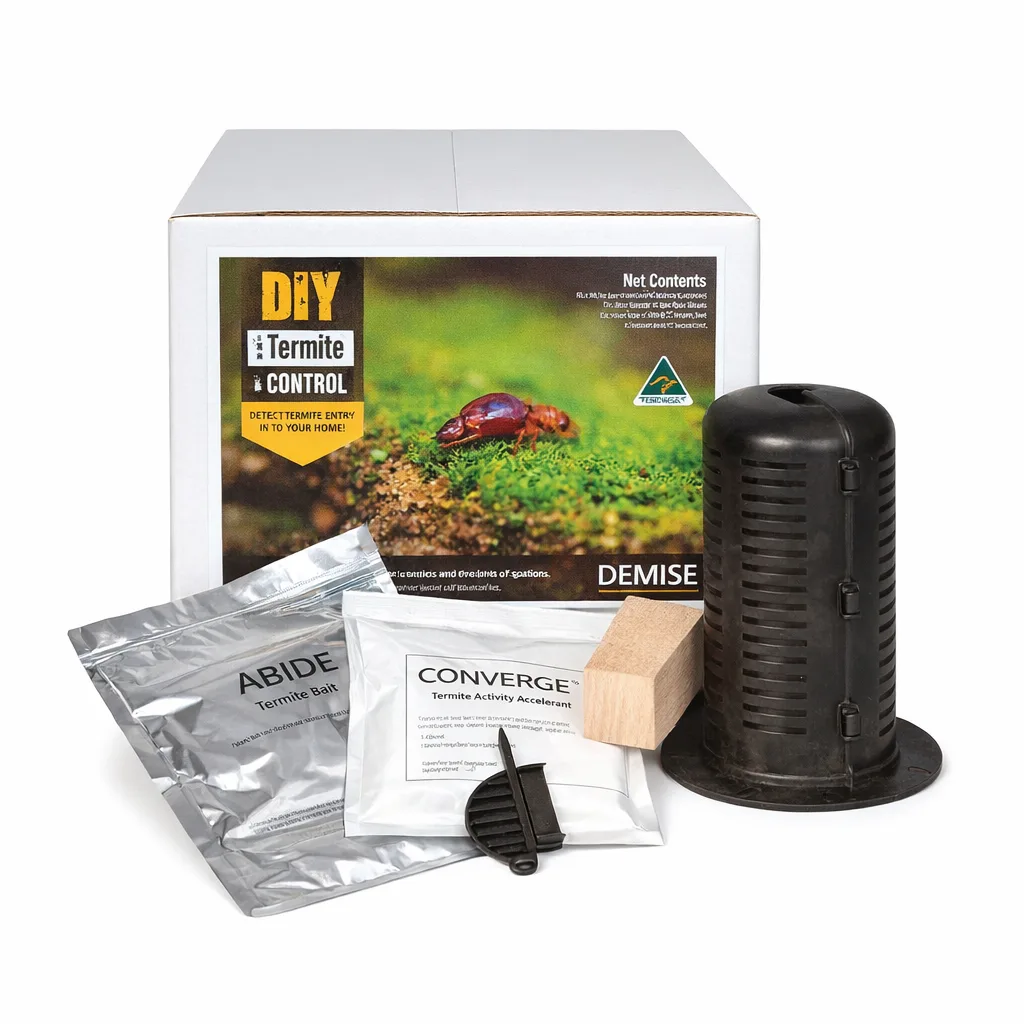
Planning five in-ground termite bait stations is mainly about creating useful monitoring coverage around the home, not simply spacing five points evenly. The DEMISE™ DIY Termite Detection & Elimination Kit is designed to monitor for termite activity first, then introduce bait into affected stations when activity is confirmed.
At a glance
Start With Spacing
Plan stations at approximately 3–5 metre intervals, then adjust for the property layout.
Choose Accessible Points
Keep every station accessible for inspection and record its position on a simple site plan.
Monitor Regularly
Inspect initially at 8–12 week intervals and record the condition of each station.
Bait On Activity
Add ABIDE™ bait only when termite activity is detected, following the product directions.
Increase Checks
Inspect active stations every 7–14 days while feeding continues.
Start with the property perimeter
Walk around the home and identify the external perimeter, accessible garden beds and other soil areas where stations can be installed. Mark possible locations before digging so you can assess the layout as a whole.
As a starting guide, plan the five stations at approximately 3–5 metre intervals around the home. This spacing creates several monitoring points around the perimeter, but it should be adjusted to suit the building footprint, paths, paving, retaining walls, gardens and other obstructions. The product directions should take priority over a general spacing plan.
Choose practical monitoring points
Each station needs to remain accessible for inspection. Avoid placing a station where it will be covered by new landscaping, blocked by stored materials or made difficult to open by dense plant growth. A location that is easy to find and service is more useful than one that is technically close to the ideal interval but likely to be forgotten.
- Use soil areas around the home where an in-ground station can be installed securely.
- Keep the station lid accessible for routine inspections.
- Consider likely termite-foraging areas and places where timber, garden structures or moisture may attract activity.
- Record the position of every station so future inspections are consistent.
- Do not assume that five evenly spaced stations cover every part of a complex property.
Use the five stations as a planned network
With a small five-station kit, coverage has to be prioritised. A simple rectangular home may allow stations to be distributed around the main sides of the building. An irregular home may require a plan that places more attention on accessible soil sections, extensions or areas where termites are more likely to forage.
Draw a basic site plan and mark the house, sheds, decks, paths, garden edges and proposed stations. Number the stations from one to five. This makes it easier to record which station contains activity and helps prevent inspections from being missed.
The kit contains five DEMISE™ in-ground bait stations, ten DEMISE™ bait wood blocks, five 50 g bags of DEMISE™ CONVERGE™ Termite Activity Accelerant and two 100 g bags of ABIDE™ Termite Bait. The wood blocks and accelerant are used during the monitoring stage; ABIDE™ bait is added when termite activity is detected.
Install according to the directions
Once the locations are planned, install each station according to the supplied product directions. Place the bait wood blocks and activity accelerant in the stations as directed, insert the stations into the prepared holes and backfill around them if required. The stations should sit securely and remain accessible for later inspection.
Use the supplied directions for any requirements relating to preparation, placement and handling. Do not treat the initial installation as a one-off control measure: the system depends on regular inspection and follow-up when activity is found.
Set an inspection schedule
Initially inspect the five stations at 8–12 week intervals. Check each numbered station for signs of termite activity and record the result, even when no activity is present. Consistent records help show whether a station has been inspected and make changes easier to identify over time.
When activity is detected, add the ABIDE™ Termite Bait as directed. The supplied instructions describe mixing the bait with bottled water into a paste and placing it directly into the affected station. Use gloved hands when mixing and handling the bait, and follow all product safety information.
Stations with feeding activity then require closer attention. Inspect them at 7–14 day intervals and replenish bait as required while feeding continues. The other stations should remain part of the broader monitoring routine rather than being ignored.
Refresh stations after feeding stops
Once feeding has ceased and no further activity is detected, remove and clean the affected stations. Fit new bait wood blocks and return the stations to the ground so they can continue to serve as monitoring points. Update your site plan and inspection record after servicing.
Know when to seek further advice
Five stations provide a set of monitoring points, but they do not guarantee that every termite risk or concealed infestation will be detected. If you find activity in the building, cannot access important parts of the perimeter, or are unsure how to interpret what you find, obtain advice from a suitably qualified termite professional. Continue following the product directions during installation, bait handling and inspections.
 Mosquito Traps